- Inflation and labor data continue to argue against near-term easing, with the market now fully pricing a December rate hike.
- The expected path of rates has moved sharply higher as the market again unwinds earlier expectations for cuts.
- For CRE borrowers, waiting for lower rates increasingly means betting that the market’s next forecast will be more accurate than its last.
Every few months, the market writes the Fed a heartfelt letter asking for rate cuts, but the Fed keeps returning it unopened. The October Consumer Price Index (CPI) rose 0.4% versus a 0.3% consensus, and core CPI rose 0.3% for a third consecutive month. Producer prices are likewise uncomfortably high, with final demand coming in at 6.5% over the 12 months, and the goods index coming in at 10.2% annually, the biggest 12-month surge since October 2022. To be fair, October’s monthly Producer Price Index (PPI) gain of 0.3% came in under the 0.4% consensus. That is a cool breeze in an otherwise hot sauna.
The labor market won’t play along with the dovish story either. Payrolls rose 165,000 in October against a forecast consensus of 70,000, and unemployment edged lower to 4.1%, while labor force participation edged up to 61.9%, a rebound from July’s 61.4%, its lowest in more than five years. Labor supply is returning without breaking demand. Wages rose 3.1% annually, though inflation-adjusted wage growth has been negative. The soft spot is that average unemployment duration jumped to 27.1 weeks. Overall, the labor market does not paint a picture of an economy in need of a rate cut.
The Federal Open Market Committee (FOMC) has noticed. Governor Waller said he was “leaning toward” a quarter-point December hike and that a 50-basis-point move “should be considered” if core CPI printed around 0.3% or higher. Core printed 0.3%. He added that hiking only 25 basis points would put the Fed’s credibility at risk. Dallas Fed President Logan sees a need for two additional quarter-point increases. Philadelphia’s Paulson said, “Further gradual tightening seems appropriate.” Chicago’s Goolsbee called the CPI report “borderline disturbing.” In October, Cook and Hammack dissented in favor of a hike.
The market’s forecasting record deserves some skepticism. Earlier this year, futures traders expected as many as two, if not three, quarter-point cuts in 2026. By June, the market had begun to price in a 25-basis-point hike. The September 2027 Fed funds rate is now priced more than 150 basis points above where markets expected it at the end of 2025. This pattern is not new. Markets priced cuts in early 2023, while the Fed kept hiking. In early 2024, the market priced six or seven cuts and got three. To be fair, the Fed did cut three-quarters of a point in late 2025. The market has not always been wrong, but it has repeatedly been too optimistic about how quickly restrictive policy would give way to easier money.
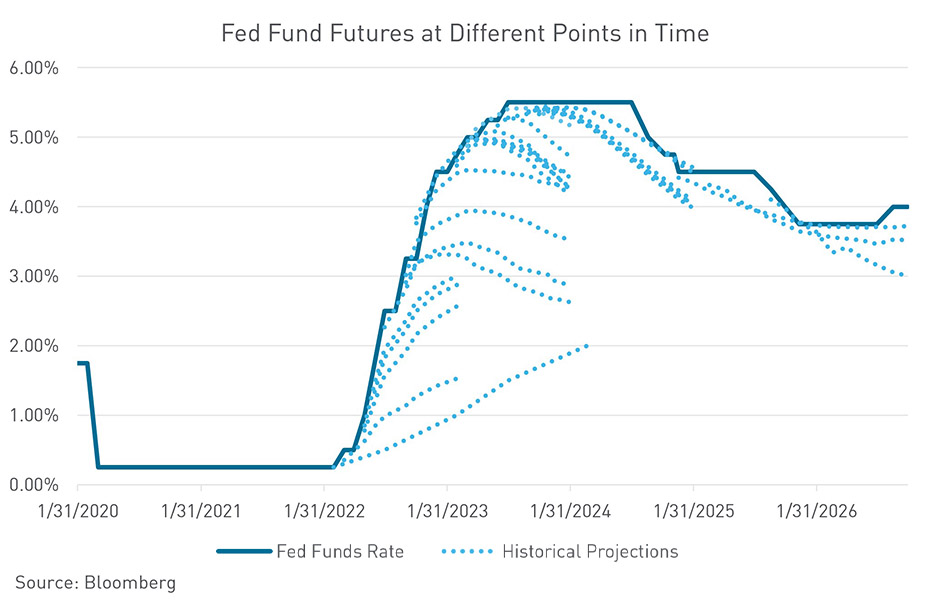
For commercial real estate, the implication is that the rate relief many were counting on may not arrive on schedule. Futures already imply a fed funds rate near 4.75% by fall 2027, above the Fed’s own median projection. History suggests even that could prove too low: Since 1994, in five of the last six tightening cycles, the Fed raised rates by more than 175 basis points. A rate path that holds at current levels or moves higher keeps financing costs elevated, pressures debt service coverage and valuations, and keeps the bid ask gap wide for transactions underwritten on the assumption of lower rates. The market was early pricing cuts in 2023, again in 2024, and again this year. Until the data and the Fed say otherwise, waiting for lower rates is a bet on a forecast, not a plan.
This commentary and any statements, information, data and content contained therein, and any materials, information, images, links, sounds, graphics or video provided in conjunction with this document (collectively “Materials”) has been prepared for informational purposes or general guidance on matters of interest only, and does not constitute professional advice, advertising or a solicitation. The Materials are of a general nature and not intended to address the circumstances of any particular individual or entity. You should not act upon the information contained in the Materials without obtaining specific professional advice. As such, nothing herein constitutes legal, financial, business, investment or tax advice and you should consult your own legal, financial, tax, investment or other professional advisor(s) before engaging in any activity in connection herewith. The information in the Materials is not a substitute for a thorough due diligence investigation. No representation or warranty (express or implied) is given as to the accuracy or completeness of the information contained in the Materials, and, to the extent permitted by law, Berkadia Commercial Mortgage LLC (together with its affiliates, the “Company”) neither accept nor assume any liability, responsibility or duty of care for any consequences of you or anyone else acting, or refraining to act, in reliance on the Materials or for any decision based on them. No part of the Materials is to be copied, reproduced, distributed or disseminated in any way without the prior written consent of the Company.