
- The FOMC voted unanimously to hold its benchmark rate steady at the 4.25%–4.50% range
- Committee updated its statement to reflect stagnant progress on lowering inflation
- The PCE inflation gauge was muted in December, tempering concerns about inflation reigniting
- Powell sidesteps tangling with the new administration, focusing purely on monetary policy
The Federal Open Market Committee (FOMC) voted to hold rates steady in the 4.25%–4.50% range at Wednesday’s meeting, putting a pause on the Fed’s cutting campaign. The statement removed language suggesting progress was being made towards the 2% inflation goal, which initially concerned the bond market until Powell clarified it was a routine update. Powell avoided political topics at the press conference despite repeated opportunities to opine. The Fed is ready to quickly respond to labor market and inflation prints as the economy continues to evolve under the new administration. Powell stated that if the job market suddenly weakened or inflation dropped significantly, the Fed could cut rates. “We are not on any preset course,” Powell said.
The Fed is entering a new “wait and see” phase for monetary policy after 100 bps of cuts in late 2024. The Fed’s preferred inflation gauge, the Personal Consumption Expenditures (PCE) price index, showed a 0.2% increase from November and a 2.8% year-over-year increase in December. These stubbornly elevated prints highlight the Fed’s concern that inflation is not trending to the 2.0% target. Powell stated that current rates are restrictive enough to curb economic activity and lower inflation, suggesting that if inflation does trend toward the 2% goal, the Fed may resume cutting rates.
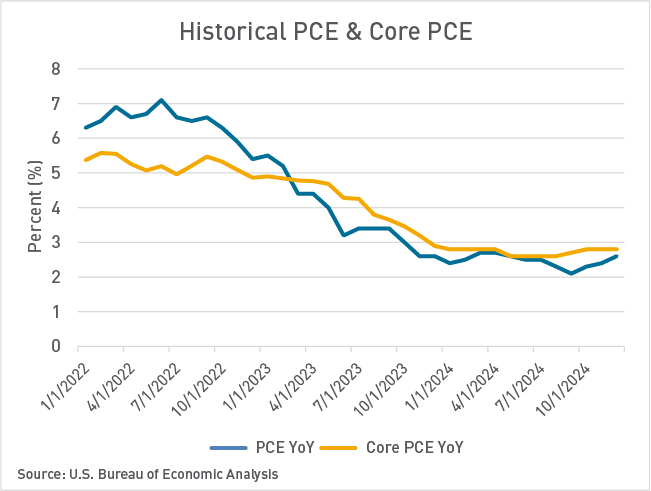
The FOMC statement on Wednesday was brief, omitting a number of topics that must have been part of the committee’s discussions: immigration, tariffs, tax cuts, and the new administration. Powell asserted Fed independence from any administration, stating it will focus on its goals and tools, unaffected by the Trump administration. He acknowledged the past trade policy’s effect on investment decisions but did not comment on the potential impact of the new administration. The Fed remains in a “wait and see” mode regarding any economic changes under the new administration.
This commentary and any statements, information, data and content contained therein, and any materials, information, images, links, sounds, graphics or video provided in conjunction with this document (collectively “Materials”) has been prepared for informational purposes or general guidance on matters of interest only, and does not constitute professional advice, advertising or a solicitation. The Materials are of a general nature and not intended to address the circumstances of any particular individual or entity. You should not act upon the information contained in the Materials without obtaining specific professional advice. As such, nothing herein constitutes legal, financial, business, investment or tax advice and you should consult your own legal, financial, tax, investment or other professional advisor(s) before engaging in any activity in connection herewith. The information in the Materials is not a substitute for a thorough due diligence investigation. No representation or warranty (express or implied) is given as to the accuracy or completeness of the information contained in the Materials, and, to the extent permitted by law, Berkadia Commercial Mortgage LLC ( together with its affiliates, the “Company”) neither accept nor assume any liability, responsibility or duty of care for any consequences of you or anyone else acting, or refraining to act, in reliance on the Materials or for any decision based on them. No part of the Materials is to be copied, reproduced, distributed or disseminated in any way without the prior written consent of the Company.