- The Fed held rates steady, but longer-term Treasury yields remain elevated as the curve steepens.
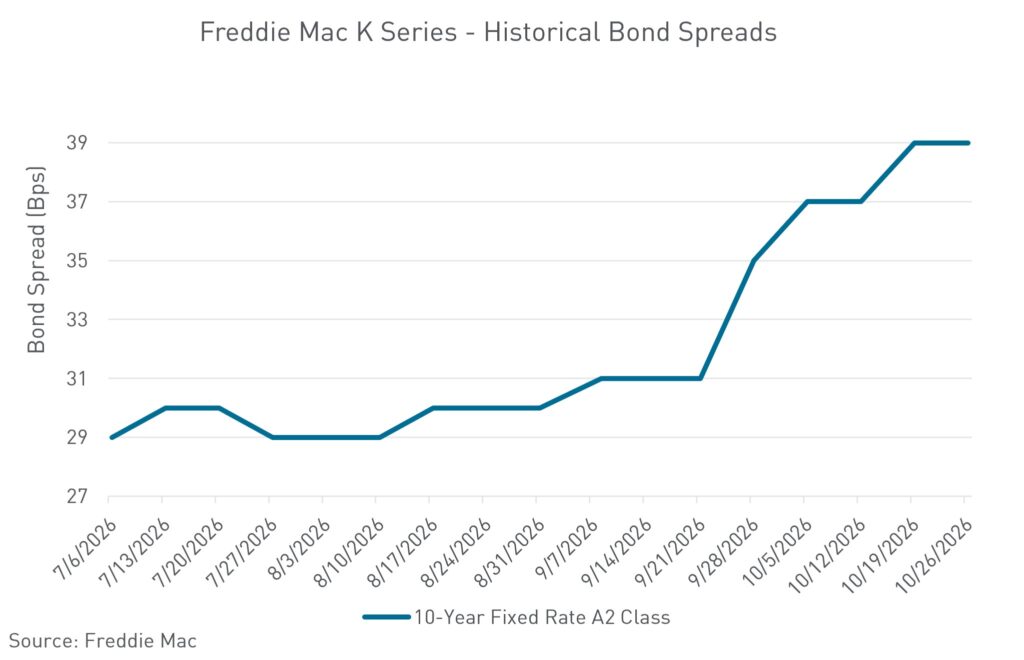
- Freddie Mac 10-year A2 spreads have widened 11 basis points from their June lows, removing some of the cushion that had helped offset higher Treasury yields.
- For CRE borrowers, a Fed pause does not necessarily translate into lower all-in borrowing costs.
The Federal Reserve held the federal funds rate at 3.75% to 4.00% this week, as widely expected. But borrowing costs didn’t follow. Long-term Treasury yields remain elevated, even after rallying off their recent highs, while agency spreads have moved wider. For commercial real estate, an unchanged Fed has not translated into cheaper financing.
The Committee’s message was also firmer than the headline decision suggested. The Fed upgraded its assessment of economic activity from “solid” to “strong,” said inflation remains elevated, and saw two members dissent in favor of another 25-basis-point increase. The economy continues to absorb restrictive monetary policy better than expected, limiting the case for near-term rate cuts.
For most of this year, the market has been looking for evidence that slower growth would give the Fed room to lower rates. Instead, consumer spending remains resilient, capital investment is robust, and productivity growth remains strong. Kevin Warsh has argued that higher productivity may allow the economy to grow faster without generating the same inflationary pressure, but the Fed is clearly not prepared to make that call yet.
The Treasury market told a similar story. The curve steepened following the meeting, with shorter-term yields moving lower, while longer-term yields initially moved higher. The 10-year Treasury spent much of the post-meeting period around 5% before rallying back to 4.93%. Even with that rally, long-term Treasury yields remain elevated and continue to put pressure on borrowing costs.
We have seen this dynamic before. In August, I wrote that the market was carrying much of the tightening burden for the Fed. Real yields remained elevated, even as the Fed was no longer actively pushing financial conditions tighter. Two months later, the mechanics have not changed much.
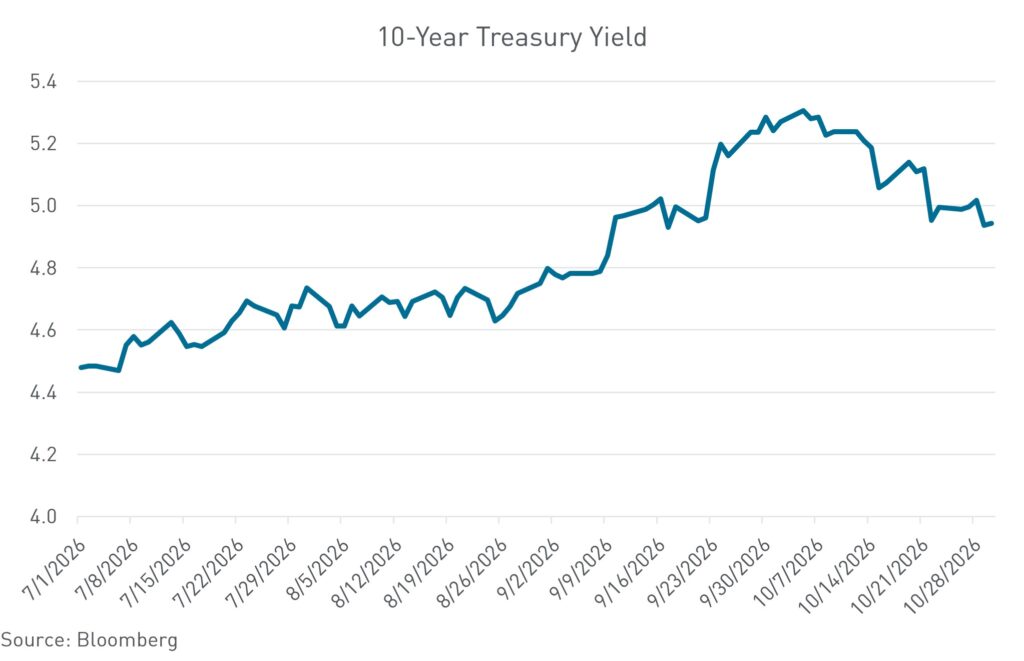
The Fed controls the overnight rate; it does not control where the 10-year Treasury trades. Stronger growth, persistent inflation, and a higher term premium can keep longer-term yields elevated, regardless of whether the next Fed move is a hike, a cut, or another hold. For commercial real estate, the path of the Treasury curve remains more important than the headline from an individual Federal Open Market Committee (FOMC) meeting.
The borrowing-cost equation has also become more difficult. Earlier this year, tighter agency spreads absorbed some of the increase in Treasury yields and helped keep all-in borrowing costs in check. That cushion is disappearing. Freddie Mac 10-year A2 spreads have widened from 31 basis points on September 21 to 39 basis points as of October 26 and are now 11 basis points wider than their June low of 28 basis points. With Treasury yields elevated and agency spreads moving wider at the same time, borrowers are no longer benefiting from one offsetting the other.
For borrowers approaching a maturity or evaluating a refinance, waiting for the Fed to deliver lower borrowing costs has become an increasingly difficult strategy. A future cut in the overnight rate does not guarantee a corresponding decline in the five- or 10-year Treasury yield. If growth remains strong and inflation remains sticky, the long end of the curve can stay elevated, even under a less restrictive Fed.
December is now the next decision point, but the path between now and then matters more than the meeting itself. The market will need to see more progress on inflation, some moderation in growth, or both, to make a sustained move lower in longer-term yields more likely. With the Fed describing economic activity as strong and two voting members already pushing for another hike, that case has not yet been made.
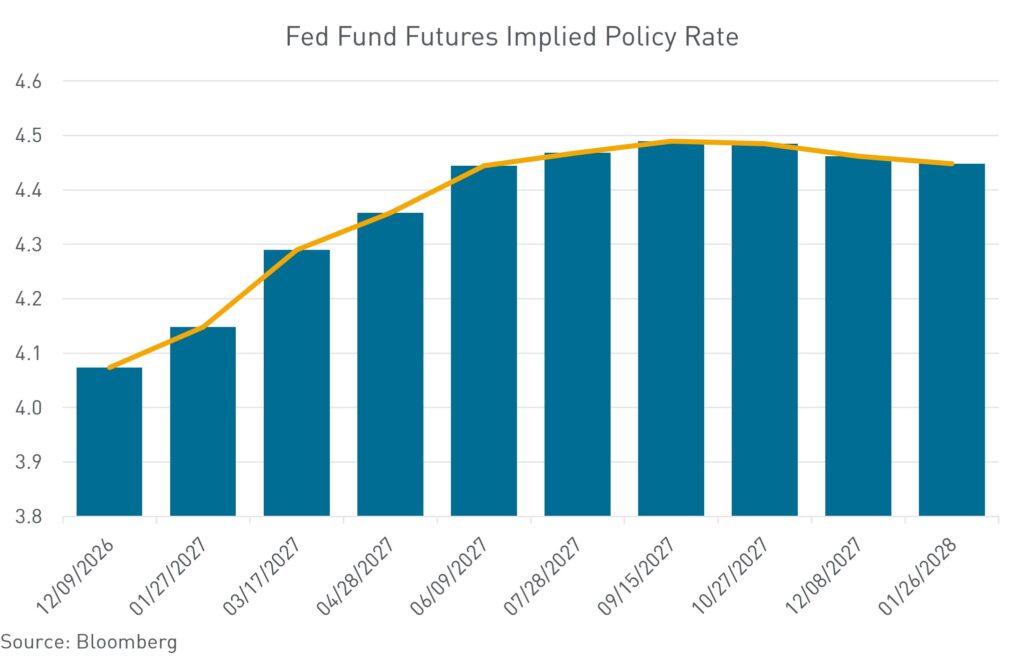
For CRE, the equation remains straightforward: stable Fed policy does not necessarily mean lower borrowing costs. Until the long end of the curve and agency spreads cooperate, the Fed can pause without delivering much relief to borrowers.
This commentary and any statements, information, data and content contained therein, and any materials, information, images, links, sounds, graphics or video provided in conjunction with this document (collectively “Materials”) has been prepared for informational purposes or general guidance on matters of interest only, and does not constitute professional advice, advertising or a solicitation. The Materials are of a general nature and not intended to address the circumstances of any particular individual or entity. You should not act upon the information contained in the Materials without obtaining specific professional advice. As such, nothing herein constitutes legal, financial, business, investment or tax advice and you should consult your own legal, financial, tax, investment or other professional advisor(s) before engaging in any activity in connection herewith. The information in the Materials is not a substitute for a thorough due diligence investigation. No representation or warranty (express or implied) is given as to the accuracy or completeness of the information contained in the Materials, and, to the extent permitted by law, Berkadia Commercial Mortgage LLC (together with its affiliates, the “Company”) neither accept nor assume any liability, responsibility or duty of care for any consequences of you or anyone else acting, or refraining to act, in reliance on the Materials or for any decision based on them. No part of the Materials is to be copied, reproduced, distributed or disseminated in any way without the prior written consent of the Company.