Real yields are doing much of the tightening work and they
offer the clearest read on the true cost of capital.
- Real yields remain elevated even as the Fed remains on hold.
- The market is doing much of the tightening work through higher borrowing costs.
- For CRE, stable rates do not necessarily mean easier capital markets.
The Federal Reserve may be holding its policy rate steady, but the cost of capital has not stood still. That distinction matters. Since last fall, the Fed has eased its overnight policy rate, yet longer-term borrowing costs remain elevated and real Treasury yields have moved higher. In other words, the market has continued to tighten financial conditions even as the Fed has stepped back from active tightening.
That is a defining macro story today.
Real yields, the return investors demand after accounting for inflation, are one of the most useful measures of the market’s assessment of the true cost of capital. When real yields rise, households, businesses, and real estate investors face a more demanding financing environment, regardless of whether the Fed changes the fed funds rate. For a central bank focused on slowing demand without unnecessarily damaging the economy, that market-led tightening can be helpful. It allows the Fed to remain patient while broader financial conditions do some of the work. But it also creates a difficult balancing act.
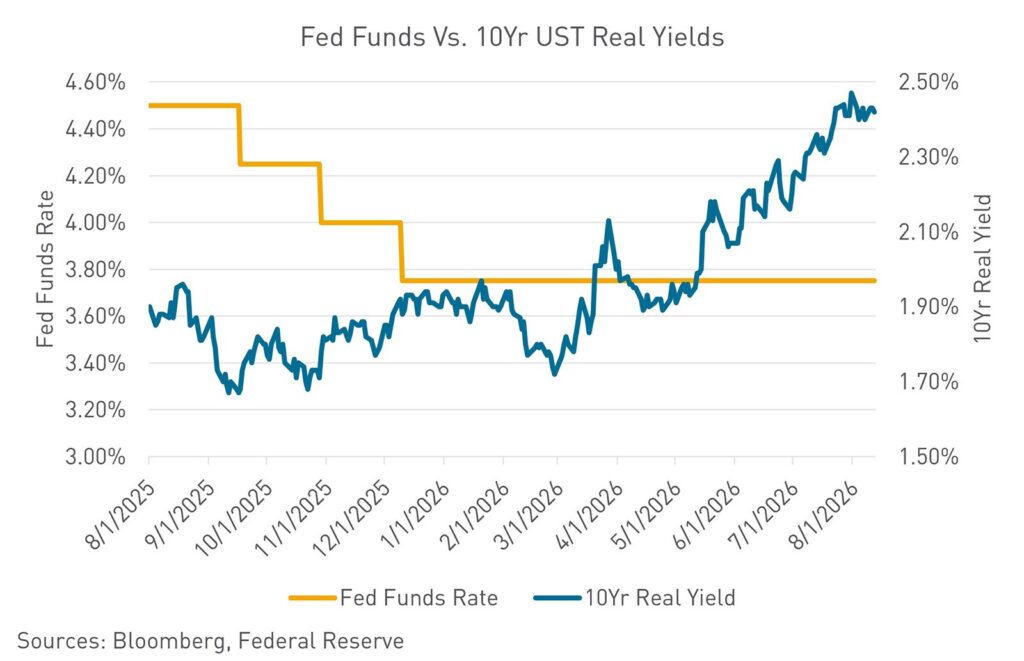
The market appears to be responding to the Fed’s message that inflation is not fully defeated and that policy cannot be evaluated solely through the overnight rate. Investors today are being asked to finance large fiscal deficits, substantial corporate investment programs, and an economy that has proven more resilient than many expected. At the same time, inflation has moderated but has not fully returned to target. Together, these forces have contributed to investors demanding greater real compensation for committing capital over longer periods. That higher required return has kept long-term rates elevated and prevented financial conditions from easing as much as conventional policy-rate comparisons might suggest.
Recent inflation readings have offered some encouragement, and the labor market appears to be cooling. Payroll growth has softened, wage growth has moderated, and consumers are showing greater sensitivity to higher financing costs. Those developments give the Fed room to wait rather than react to every data release.
Corporate investment remains supported by the buildout of AI infrastructure and the broader push toward productivity-enhancing capital expenditures. That investment could ultimately expand productive capacity and help ease inflationary pressure over time. In the near term, however, it also supports demand, capital needs, and economic activity. The same tension exists across the broader economy: growth is cooling, but it is not collapsing; inflation is moderating, but it has not yet returned decisively to target; and the Fed is on hold, but financial conditions remain restrictive. That leaves real yields at the center of the outlook.
If real yields remain elevated, the market will continue to impose discipline on interest-rate-sensitive sectors. For commercial real estate, elevated real yields continue to support a higher cost-of-capital environment. Debt remains expensive relative to historical norms, loan proceeds remain constrained, and investors continue to place a premium on durable cash flow and realistic underwriting assumptions. Stable rates are helpful, but stable does not necessarily mean easy.
If, however, yields fall quickly and financial conditions loosen materially before inflation is convincingly contained, the Fed’s credibility could again come into focus. The market’s willingness to carry some of the tightening burden depends on its belief that policymakers will act if inflation or inflation expectations begin moving in the wrong direction. That credibility dynamic has been a recurring theme throughout the Warsh era and remains one of the most important variables for markets going forward.
That is the key risk for the remainder of 2026 and into 2027. The question is not simply whether the Fed will raise, cut, or hold. It is whether the broader market will continue to require a sufficiently high real return to keep demand in check without forcing the Fed back into a more aggressive posture. For now, the answer appears to be yes.
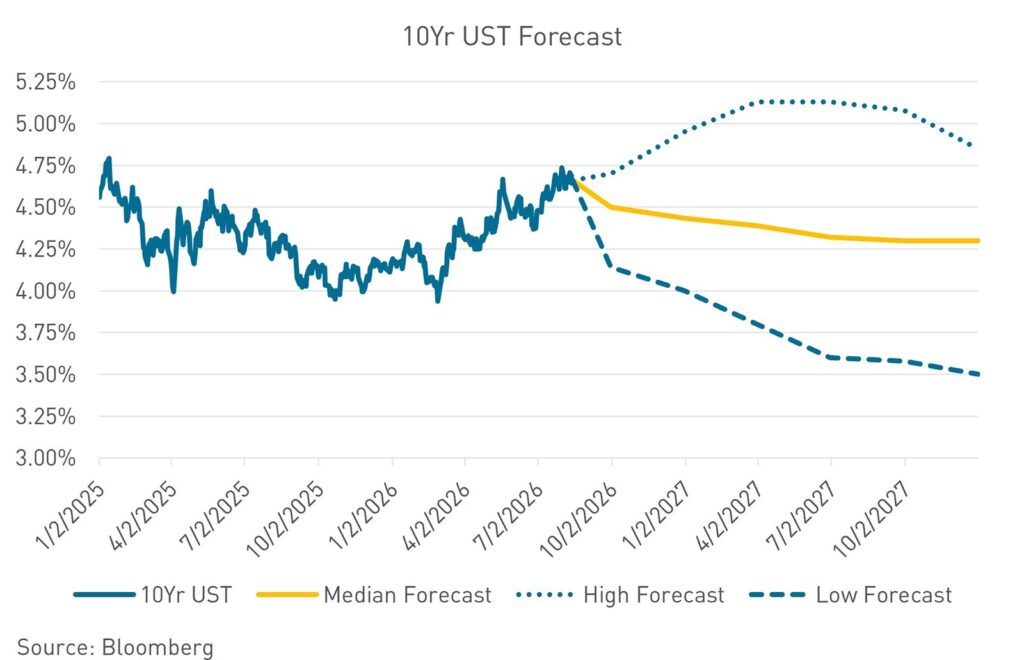
The result is a more nuanced rate environment than a simple “higher for longer” narrative suggests. Long-term rates may remain volatile and elevated, but the next major move will depend on the interaction among inflation progress, labor-market cooling, investment demand, fiscal supply, and the market’s confidence in Fed credibility. The real-yield signal remains clear: capital is still expensive. Until that changes, it is difficult to envision a materially easier financing environment, regardless of where the Fed chooses to set the overnight rate.
This commentary and any statements, information, data and content contained therein, and any materials, information, images, links, sounds, graphics or video provided in conjunction with this document (collectively “Materials”) has been prepared for informational purposes or general guidance on matters of interest only, and does not constitute professional advice, advertising or a solicitation. The Materials are of a general nature and not intended to address the circumstances of any particular individual or entity. You should not act upon the information contained in the Materials without obtaining specific professional advice. As such, nothing herein constitutes legal, financial, business, investment or tax advice and you should consult your own legal, financial, tax, investment or other professional advisor(s) before engaging in any activity in connection herewith. The information in the Materials is not a substitute for a thorough due diligence investigation. No representation or warranty (express or implied) is given as to the accuracy or completeness of the information contained in the Materials, and, to the extent permitted by law, Berkadia Commercial Mortgage LLC ( together with its affiliates, the “Company”) neither accept nor assume any liability, responsibility or duty of care for any consequences of you or anyone else acting, or refraining to act, in reliance on the Materials or for any decision based on them. No part of the Materials is to be copied, reproduced, distributed or disseminated in any way without the prior written consent of the Company.