A hawkish Fed Chair, softer inflation data, and a credibility test arriving sooner than the market may expect.
- Markets priced the hike even though the Fed didn’t deliver one.
- Warsh argued higher yields already did some of the Fed’s work.
- Softer inflation data buys time, but not unlimited credibility
Markets came into Wednesday’s FOMC meeting focused on one question: why didn’t the Fed raise rates? Warsh seemed focused on a different one entirely: how much tightening had already occurred since the last meeting?
The FOMC voted 9-3 to leave the fed funds rate unchanged at 3.50%-3.75%, with three dissents once again highlighting a growing hawkish faction inside the Committee. But the more important story wasn’t the vote itself. Throughout his press conference, Warsh repeatedly pointed to the rise in both nominal and real Treasury yields since June. His message was straightforward: financial conditions have tightened materially over the last six weeks, even without a change in the fed funds rate. In his view, policy doesn’t work solely through the rate the Fed controls. It works through the broader financial conditions facing households and businesses, and those conditions have already become more restrictive.
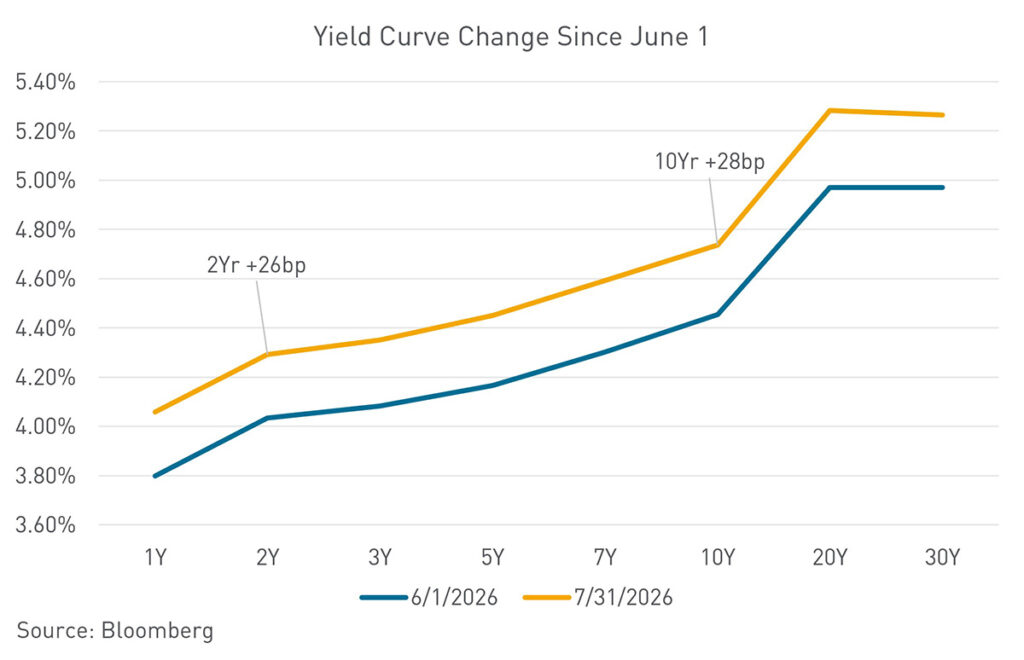
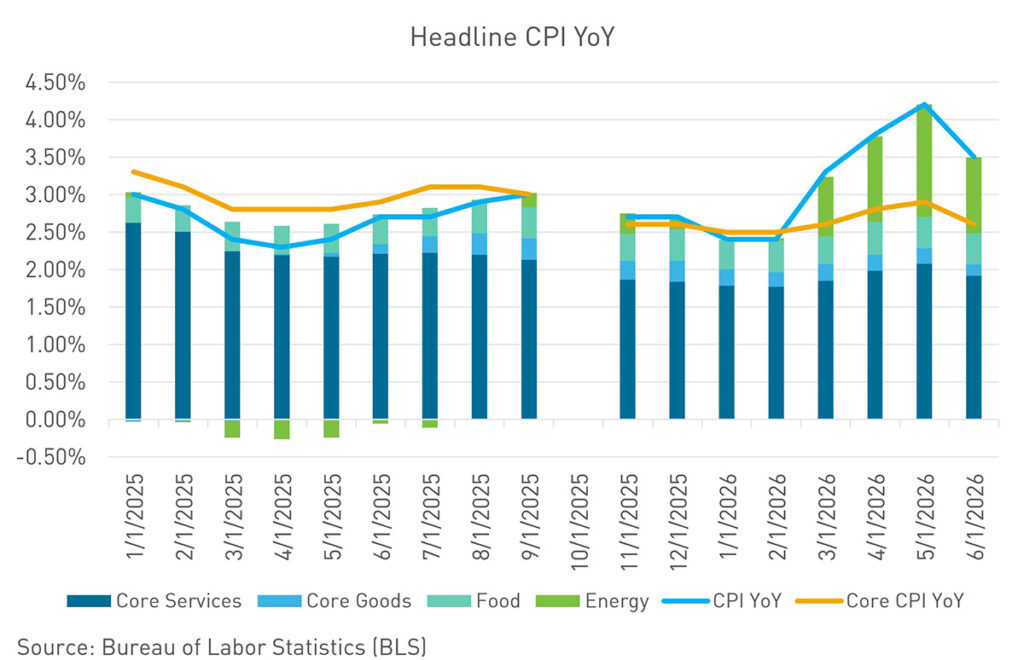
The defining line from the meeting remains: “Play the ball, not the referee.” That seems to be at the core of how Warsh wants investors to think about the economy. Stop trying to predict every Fed move and focus on what’s actually happening underneath the surface. Growth matters. Inflation matters. Labor markets matter. Productivity and business investment matter. Warsh is clearly trying to shift the conversation away from Fed-watching and back toward economic fundamentals. He also went out of his way to downplay the importance of any single inflation report. The message was straightforward: don’t build an entire Fed forecast around one Consumer Price Index (CPI) print.
Warsh brought up the amount of capital expenditures (CAPEX) in the broader economy as a central theme for some of the conversations at this week’s meeting. He seems to view the AI-driven investment boom as one of the most important forces shaping the economy today. On one hand, that investment can boost productivity and expand capacity, helping offset inflation pressures over time. On the other, it can create additional demand in the near term. That tension appears to sit at the center of how he is thinking about growth, inflation, and policy.
The most interesting dynamic, however, may be the game of chicken developing between the market and the Fed. Investors spent the last six weeks pushing Treasury yields and real rates higher because they believed Warsh was willing to tighten further if inflation failed to cooperate. In effect, the market did some of the Fed’s work for it. Then Warsh showed up this week and pointed to that tightening in financial conditions as part of the rationale for leaving rates unchanged. The market tightened because it believed Warsh was serious about fighting inflation. Warsh then relied on that tightening as justification for not acting. The question now is whether that equilibrium can hold. The implied Fed funds rate, despite a quick dip post-meeting, still shows strong expectations of rate hikes this year coming from the Warsh Fed.
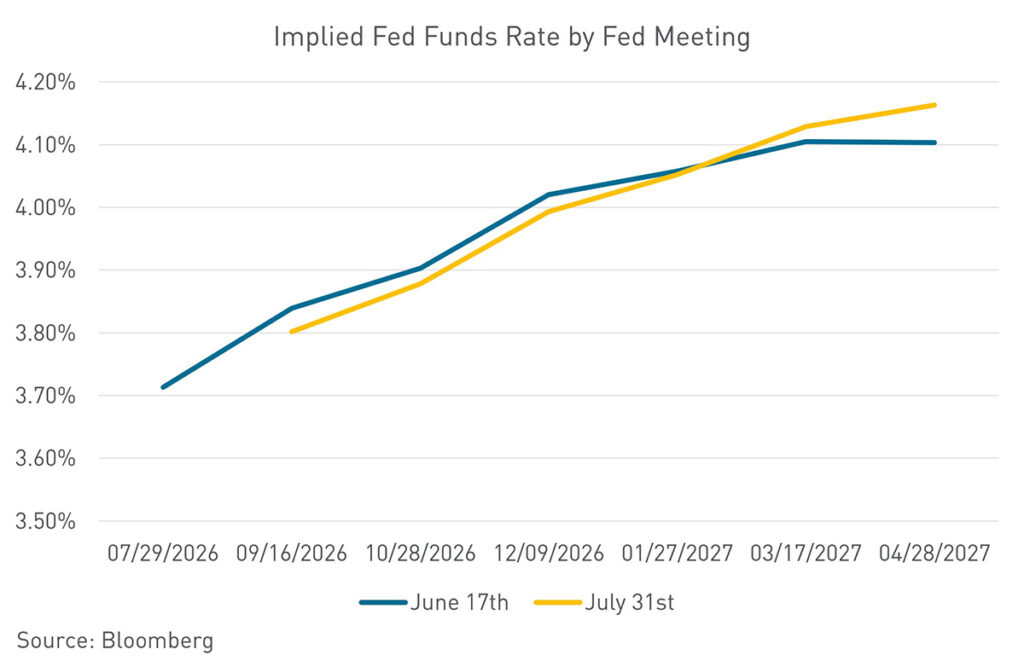
That’s what makes Jackson Hole and the September FOMC meeting so important. If yields remain elevated and financial conditions stay restrictive, Warsh may be comfortable waiting. But if markets interpret this week’s decision as the beginning of the end of the tightening cycle and financial conditions ease, his credibility could face an early test. The complicating factor is that both CPI and Personal Consumption Expenditures (PCE) have recently come in a bit softer than expected, giving him cover to be patient. The market is now balancing two competing narratives: inflation has shown signs of improvement, but the Fed Chair continues to sound far more concerned about inflation risks than someone eager to declare victory.
The biggest takeaway from this week’s meeting may be that Warsh is trying to use market expectations as part of the policy toolkit. The market spent the last six weeks tightening financial conditions because it believed he was prepared to raise rates if inflation didn’t cooperate. This week, he effectively argued that the move reduced the need to act. The challenge is that this only works if investors continue to believe him. If the market concludes that hawkish rhetoric won’t ultimately be backed by action, financial conditions could ease just as quickly as they tightened. That doesn’t mean cuts are around the corner, but it does create the risk that longer-term inflation expectations begin drifting higher and rates have to move even further to restore credibility. That’s why Jackson Hole and September matter so much. This week’s decision wasn’t the end of the story. It was the beginning of a test.
This commentary and any statements, information, data and content contained therein, and any materials, information, images, links, sounds, graphics or video provided in conjunction with this document (collectively “Materials”) has been prepared for informational purposes or general guidance on matters of interest only, and does not constitute professional advice, advertising or a solicitation. The Materials are of a general nature and not intended to address the circumstances of any particular individual or entity. You should not act upon the information contained in the Materials without obtaining specific professional advice. As such, nothing herein constitutes legal, financial, business, investment or tax advice and you should consult your own legal, financial, tax, investment or other professional advisor(s) before engaging in any activity in connection herewith. The information in the Materials is not a substitute for a thorough due diligence investigation. No representation or warranty (express or implied) is given as to the accuracy or completeness of the information contained in the Materials, and, to the extent permitted by law, Berkadia Commercial Mortgage LLC ( together with its affiliates, the “Company”) neither accept nor assume any liability, responsibility or duty of care for any consequences of you or anyone else acting, or refraining to act, in reliance on the Materials or for any decision based on them. No part of the Materials is to be copied, reproduced, distributed or disseminated in any way without the prior written consent of the Company.