Why Agency borrowers have been helped more by spread compression than Treasury policy
- Agency CMBS spreads have maintained a holding pattern for nearly 7 months
- Inflation continues to linger above the Fed’s stated 2% goal
- U.S. Treasury makes a play to drive interest rates tighter
There has been a lot of ink spilled recently about Treasury Secretary Scott Bessent’s announcement that the Treasury Department will increase its buybacks of longer-dated securities. But let’s not conflate the Treasury and the Fed. The Treasury’s job is to finance the government. The Fed’s job is to maintain price stability and employment. For years, investors have looked to the Fed when policymakers wanted to influence financial conditions or borrowing costs. Treasury’s recent actions don’t carry the same firepower. Treasury can’t create reserves, expand the money supply, or conduct quantitative easing. What it can do is use debt-management tools in an attempt to influence liquidity and, at the margin, longer-term borrowing costs. That’s why the rally following Bessent’s announcement faded so quickly. The market recognized that Treasury may be stepping into territory normally associated with the Fed, but it’s doing so without the Fed’s toolkit. Treasury may be crossing lanes, but it isn’t driving the same vehicle.
That set up Kevin Warsh’s Jackson Hole speech. The administration has made little secret of its desire to see long-term borrowing costs move lower. The bond market, meanwhile, continues to send a different message. Higher yields are the market’s way of demanding compensation for persistent inflation, growing government borrowing needs, geopolitical uncertainty, and the possibility that structurally higher rates are becoming a feature rather than a bug of the post-pandemic economy. Recent Treasury actions may have been intended to send a signal, but the market has largely responded with a reminder that it still determines the clearing price for capital.
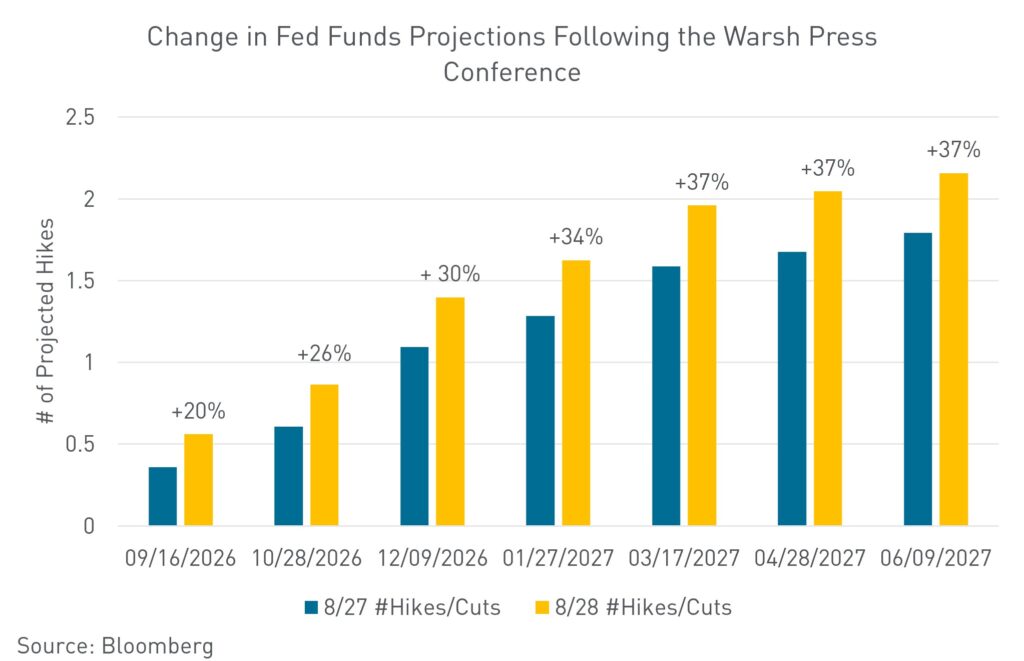
Warsh did not provide a roadmap for the next meeting. He provided a statement about how he intends to run the institution. He called the Fed’s 2% PCE inflation objective a firm, fixed target, said its primary focus should remain on prices, and argued that unconventional tools should be used sparingly outside genuine crises. Just as important, he reinforced his effort to move the Fed away from heavy forward guidance. Markets should draw their own conclusions about growth, employment, and inflation rather than looking to the Fed for their next trade. His message was less about a specific policy decision and more about discipline: the Fed will listen to market signals, but it will not pre-commit its policy path or substitute Treasury’s debt-management goals for its own mandate. The market responded with a surge in expectations of an upcoming rate hike and a flattening of the curve, with the shorter end moving materially higher immediately after the speech.
As rapidly as the macroeconomic space continues to shift, Agency Commercial Mortgage-Backed Securities (CMBS) spreads and the market as a whole have been a bastion of stability for nearly seven months in nearly all segments of the market. Dating back to January of this year when President Trump directed Fannie Mae and Freddie Mac to buy $200 billion of mortgage-backed securities (MBS), spreads have sat at near historic tights. On the heels of the announcement, government-sponsored enterprise (GSE) spreads gapped nearly 15 bps tighter across tenors, and Ginnie Mae 223f spreads followed in tandem, tightening roughly 25 bps in that same time frame.
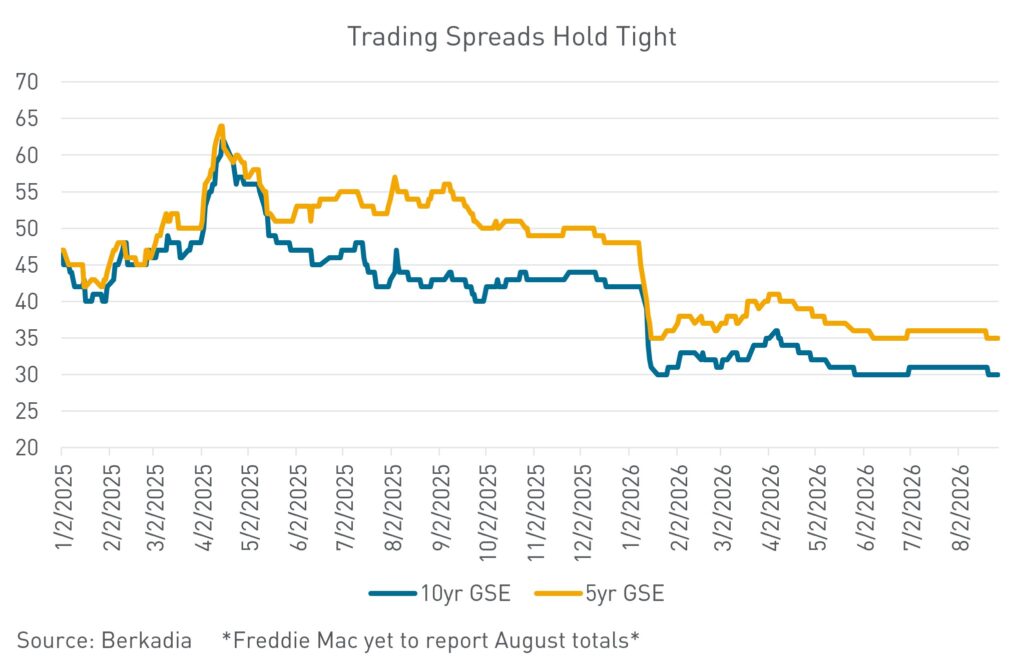
While Washington debates how to bring long-term borrowing costs down, Agency borrowers have quietly benefited from a different source of relief. Agency CMBS spreads have spent much of 2026 holding near historically tight levels, offsetting some of the upward pressure coming from Treasury yields and helping keep all-in borrowing costs more stable than many expected. The bigger question now is not whether Treasury can influence rates. It’s whether the technical factors supporting these unusually tight spreads can persist as issuance returns later this year.
The surprising part isn’t that Agency spreads tightened following the Administration’s January directive that Fannie Mae and Freddie Mac purchase an additional $200 billion of mortgage-backed securities—it’s that they never widened back out. Agency spreads remain near the tightest levels seen in years despite a macro backdrop that has included elevated inflation, rising long-term Treasury yields, and persistent volatility across rates markets. In most cycles, spreads would have given back a meaningful portion of that move. Instead, they have spent nearly seven months holding their ground.
The primary reason has been a simple supply-and-demand story. The Federal Housing Finance Agency (FHFA) increased multifamily purchase caps to $88 billion per agency for 2026, but issuance has lagged well behind the pace needed to reach those limits. Fannie Mae is running effectively flat to last year on published volume flows, and while reported Freddie Mac business activity is up nearly 21% year over year, the agencies still have roughly $100 billion of lending capacity they can deploy before year-end. In other words, both agencies remain well below the pace needed to fully utilize their available capacity. At the same time, end-account demand has remained healthy while the new-issue calendar has stayed remarkably light. The result has been a shortage of product at a time when investors continue to seek Agency exposure. That imbalance has helped keep spreads stable despite a rates market that has provided very little stability elsewhere.
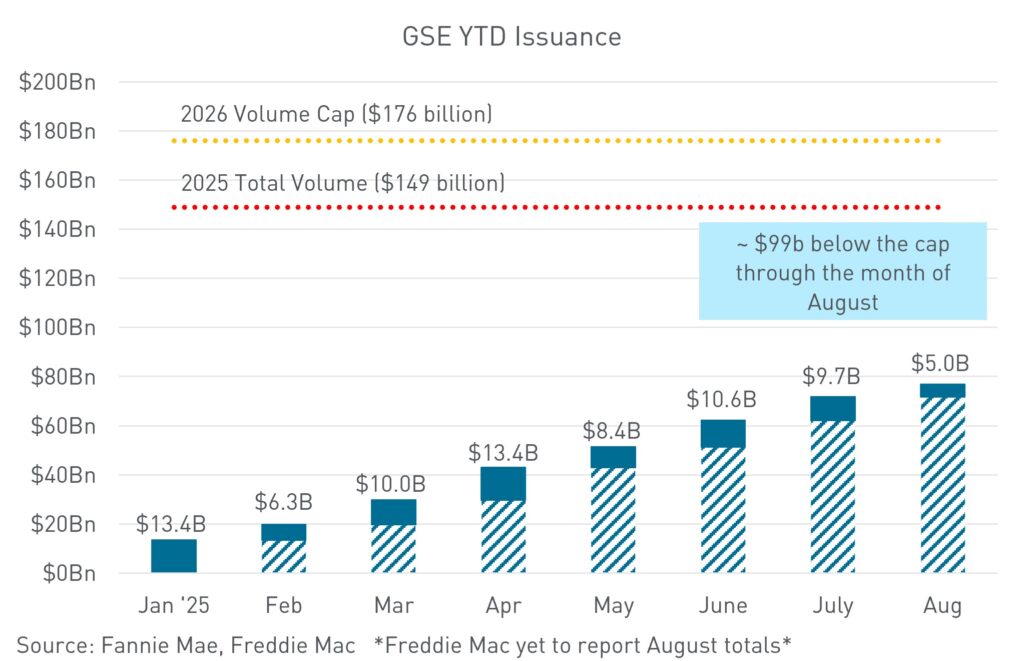
The near-term outlook suggests those technicals are unlikely to disappear overnight. Summer issuance has been exceptionally light, with Delegated Underwriting and Servicing (DUS) trading volumes running below historical norms and Freddie Mac supply remaining limited through Labor Day. That lack of available paper has left investors competing for a relatively small amount of product and has helped prevent meaningful spread widening. For borrowers, that has been an important counterweight to higher Treasury yields. Had spreads simply normalized toward historical averages over the past several months, all-in borrowing costs would look materially different today.
That said, the first signs of pressure are beginning to emerge. Swap spreads have widened, Ginnie Mae (GNMA) spreads have begun drifting wider, and issuance is expected to increase as summer gives way to the fall production season. The next several weeks will provide the most meaningful test this market has faced all year. If demand remains strong enough to absorb new supply, Agency spreads may continue their remarkable run of stability. If supply begins to outpace demand, the market could finally begin the slow process of normalizing from historically tight levels. For Agency borrowers, that question may prove more important than anything said at Jackson Hole because spread behavior has done as much to shape borrowing costs this year as the Treasury market itself.
This commentary and any statements, information, data and content contained therein, and any materials, information, images, links, sounds, graphics or video provided in conjunction with this document (collectively “Materials”) has been prepared for informational purposes or general guidance on matters of interest only, and does not constitute professional advice, advertising or a solicitation. The Materials are of a general nature and not intended to address the circumstances of any particular individual or entity. You should not act upon the information contained in the Materials without obtaining specific professional advice. As such, nothing herein constitutes legal, financial, business, investment or tax advice and you should consult your own legal, financial, tax, investment or other professional advisor(s) before engaging in any activity in connection herewith. The information in the Materials is not a substitute for a thorough due diligence investigation. No representation or warranty (express or implied) is given as to the accuracy or completeness of the information contained in the Materials, and, to the extent permitted by law, Berkadia Commercial Mortgage LLC ( together with its affiliates, the “Company”) neither accept nor assume any liability, responsibility or duty of care for any consequences of you or anyone else acting, or refraining to act, in reliance on the Materials or for any decision based on them. No part of the Materials is to be copied, reproduced, distributed or disseminated in any way without the prior written consent of the Company.